


Beyond the Balance Sheet: 10 Questions to Ask Before Outsourcing Your Law Firm’s Bookkeeping

For a law firm, bookkeeping isn't just about tracking profit and loss—it’s about protecting your license. One accounting error in a trust account can lead to devastating consequences with the State Bar.
At Legal Back Office, we want to support you in your quest to find the perfect outsourced vendor. When you decide to outsource your firm’s financial management, you aren't just looking for someone to "do the math"; you are looking for a partner in compliance. To ensure your firm stays profitable and protected, here are the top 10 questions you should ask any potential bookkeeping partner.
1. What experience do you have specifically with law firm accounting and trust/IOLTA compliance?
General bookkeeping and legal bookkeeping are worlds apart. Ask for specifics. Do they understand the difference between earned and unearned income? Are they familiar with the strict rules governing IOLTA accounts in your specific state?
2. How do you handle trust accounting, three-way reconciliations, and state bar compliance?
A "three-way reconciliation" (matching the bank balance, the book balance, and the individual client ledgers) is the gold standard for legal compliance. If a provider cannot explain their process for this, they aren't the right fit for a law firm.
Why it matters: Most bar audits fail because of discrepancies between client ledgers and the trust bank account.
3. Which practice management and accounting systems do you support?
Your bookkeeping shouldn't live in a silo. Your partner should be experts in the tools you already use, such as:
• Practice Management: Clio, MyCase, CosmoLex, or LeanLaw
• Accounting: QuickBooks Online or Xero
• Integration: Ensuring these two systems "talk" to each other correctly
4. What is included in your monthly scope versus billed additionally?
Avoid "invoice shock." Ask for a clear breakdown of what is covered in your flat monthly fee. Does it include payroll? 1099 processing? Sales tax? Understanding the boundaries of the contract helps you manage your overhead.
5. How do you handle historical clean-up or "messy books"?
Many firms seek help because their current books are a disaster. Ask if they have a dedicated "Clean-up" phase to audit previous months or years before transitioning to ongoing maintenance.
6. What does your monthly close process look like, and when are financials delivered?
Data is only useful if it’s timely. A professional partner should have a set schedule.
• The Close: When are all transactions categorized?
• The Delivery: Will you have your reports by the 10th of the month? The 15th?
7. Who is actually doing the work, and who reviews it?
You need to know the hierarchy of your financial team. Is your work being handled by a junior bookkeeper and then reviewed by a Controller or CPA? Having a "second set of eyes" is a critical internal control to prevent fraud and errors.
8. How do you handle client reimbursements and expense classifications?
Specifically, ask how they differentiate between reimbursable (advanced) costs and non-reimbursable firm expenses. Misclassifying these can lead to tax errors and lost revenue for the firm.
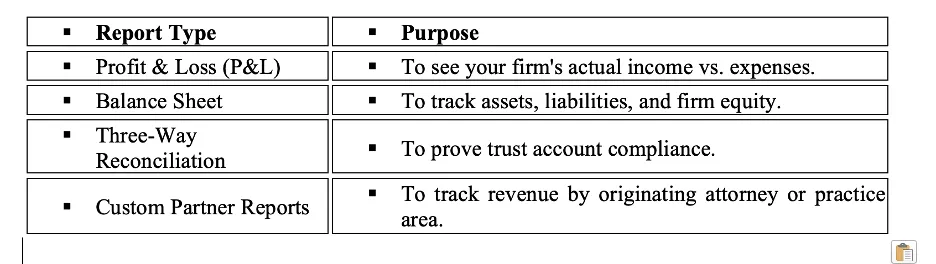
9. What reports will we receive regularly, and can they be customized?
Financial statements should be more than a PDF in your inbox. Below are the standard reports you should expect:
10. How do you communicate issues, questions, or compliance risks?
If a check bounces or a trust account is overdrawn, you need to know immediately. Ask about their communication protocol: Do they use a client portal, email, or scheduled monthly zoom calls?
The Bottom Line
Outsourcing your bookkeeping to a legal-specific partner like Legal Back Office does more than just clear your desk of paperwork—it provides the peace of mind that your firm is compliant and your financial data is actionable.
If you are ready to professionalize your firm's finances and eliminate the stress of compliance, reach out to Legal Back Office today. Allow our team of legal accounting experts to support your needs, from daily entries to complex trust reconciliations. We provide the specialized expertise your firm deserves, letting you focus on your clients while we handle the complexities of your books.

.svg)

Copyright © 2025 – All Rights Reserved – Site Design by Legal Back Office